
Kitesurfing wind guide: knots, gusts and kite size explained

Kitesurfers measure wind in knots, and one knot is 1.852 km/h, so a forecast of 30 km/h is only about 16 knots. The number is just the start. What decides whether a day works is the gap between steady wind and gusts, the direction the wind blows relative to the shore, and how your weight and kite size match the wind. Offshore wind, which blows from the land out to sea, is the direction to respect most.
This kitesurfing wind guide gives rules of thumb, not rules: no table can tell you whether a particular day is right for you, and the safest way to learn is with a qualified instructor.
The short version: convert every forecast to knots, read the gusts as well as the average, know what "offshore" means at your beach, and if you are unsure, do not launch.
Knots, km/h and mph: making the number usable
Weather apps show wind in knots, km/h, mph or metres per second; kite size charts use knots. One knot is 1.852 km/h by definition, which is about 1.15 mph or 0.51 metres per second. The table rounds common readings to whole numbers and adds the Beaufort force used in many sea forecasts.
| Knots | km/h | mph | Beaufort force |
|---|---|---|---|
| 8 | 15 | 9 | 3 (gentle breeze) |
| 10 | 19 | 12 | 3 (gentle breeze) |
| 12 | 22 | 14 | 4 (moderate breeze) |
| 15 | 28 | 17 | 4 (moderate breeze) |
| 18 | 33 | 21 | 5 (fresh breeze) |
| 20 | 37 | 23 | 5 (fresh breeze) |
| 25 | 46 | 29 | 6 (strong breeze) |
| 30 | 56 | 35 | 7 (near gale) |
Beaufort is a rough scale: use it to recognise a sea forecast's wording, not to decide whether to go out.
Converting in your head
- From km/h: halve the number, then add a tenth of that. 30 km/h gives 15, then 16.5, against a true 16.2 knots.
- From mph: take off about an eighth. 20 mph gives 17.5 knots, against a true 17.4.
The unit trap
The classic mistake is reading a km/h forecast as knots. A forecast of 30 km/h is about 16 knots, while a forecast of 30 knots is about 56 km/h, a near gale. Check the unit next to the number first, because it is often in small type.
Steady wind and gusts
A forecast usually gives two figures: the steady wind, and gusts, the short peaks above it. KiteMood's wind page makes the practical point plainly: a big gap between the two means the wind will feel less steady on the water.
A kite feels every surge and dip: you are pulled hard in a gust and lose power in the lull after it. One retailer's safety guide says gusts usually last under about 20 seconds.
Why wind turns gusty
The same guide names three common causes: obstacles in the wind's path, wind shear (layers of air moving at different speeds or in different directions) and thermals (warm air rising on sunny days).
How big a gap is too big?
The sources behind this guide give no percentage rule. The retailer's example is that 15 to 20 knots with gusts to 25 is easier to ride than the same wind gusting to 30, so the spread matters as much as the average. The school's view is that beginners usually learn best in moderate, steady wind.
Wind direction: onshore, cross-shore and offshore
A wind direction is named for where the wind comes from, so a north-westerly blows from the north-west. For kitesurfing the compass point matters less than the angle to the shore, which depends on how the beach faces.
| Name | The wind blows... | What it means for you |
|---|---|---|
| Onshore | from the sea towards the land | Pushes you back towards the beach, so drifting is less of a worry than with offshore wind |
| Cross-onshore | across the beach, with some push from the sea | Usually preferred for kitesurfing, along with cross-shore |
| Cross-shore | along the beach, parallel to the shore | You are neither pushed onto the beach nor away from it |
| Cross-offshore | across the beach, with some push away from the land | Can carry you gradually away from shore, so treat it with the caution of offshore wind |
| Offshore | from the land out to sea | The risky one: it can blow you away from the shore |
Why offshore wind is the one to respect
If you lose control, fall and cannot relaunch, or run out of strength, offshore wind carries you away from the shore instead of back to it, and help has further to come. That is why several operators and regulators advise against kitesurfing in offshore wind unless a rescue boat is available. One national tourism authority publishes it as a guideline.
Direction at the Marsa Alam lagoon
KiteMood describes the wind at its lagoon as cross to cross-onshore. For wider context, satellite-based research on the Red Sea finds that north of about 19 to 20 degrees north, which includes Marsa Alam, the prevailing winds typically blow from the north-west through the year. That is basin-wide research, not a measurement at the lagoon, and a compass direction only becomes "onshore" or "cross-shore" once you know how the beach faces, so ask the team what it means on the day.
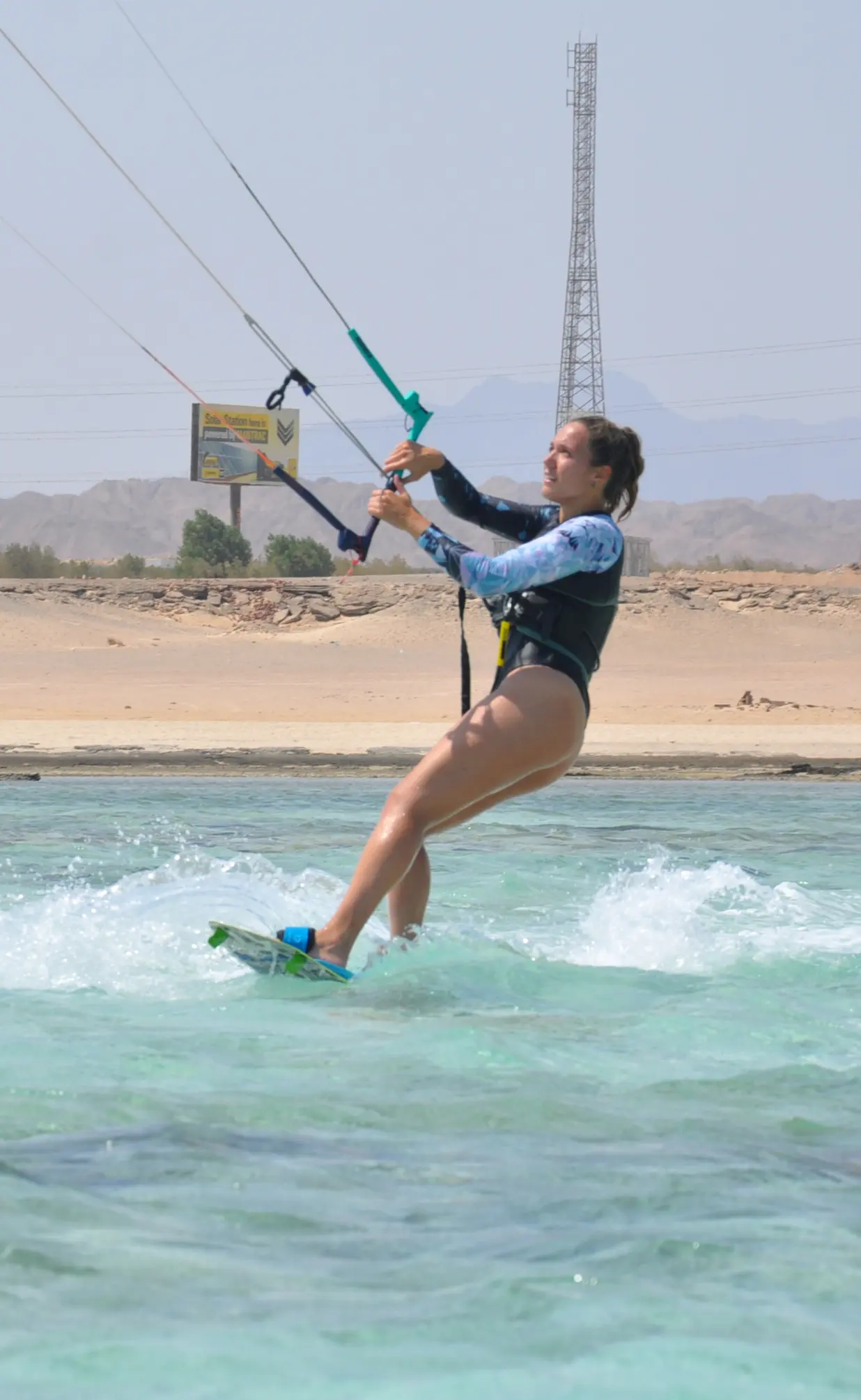
Kite size, wind and rider weight
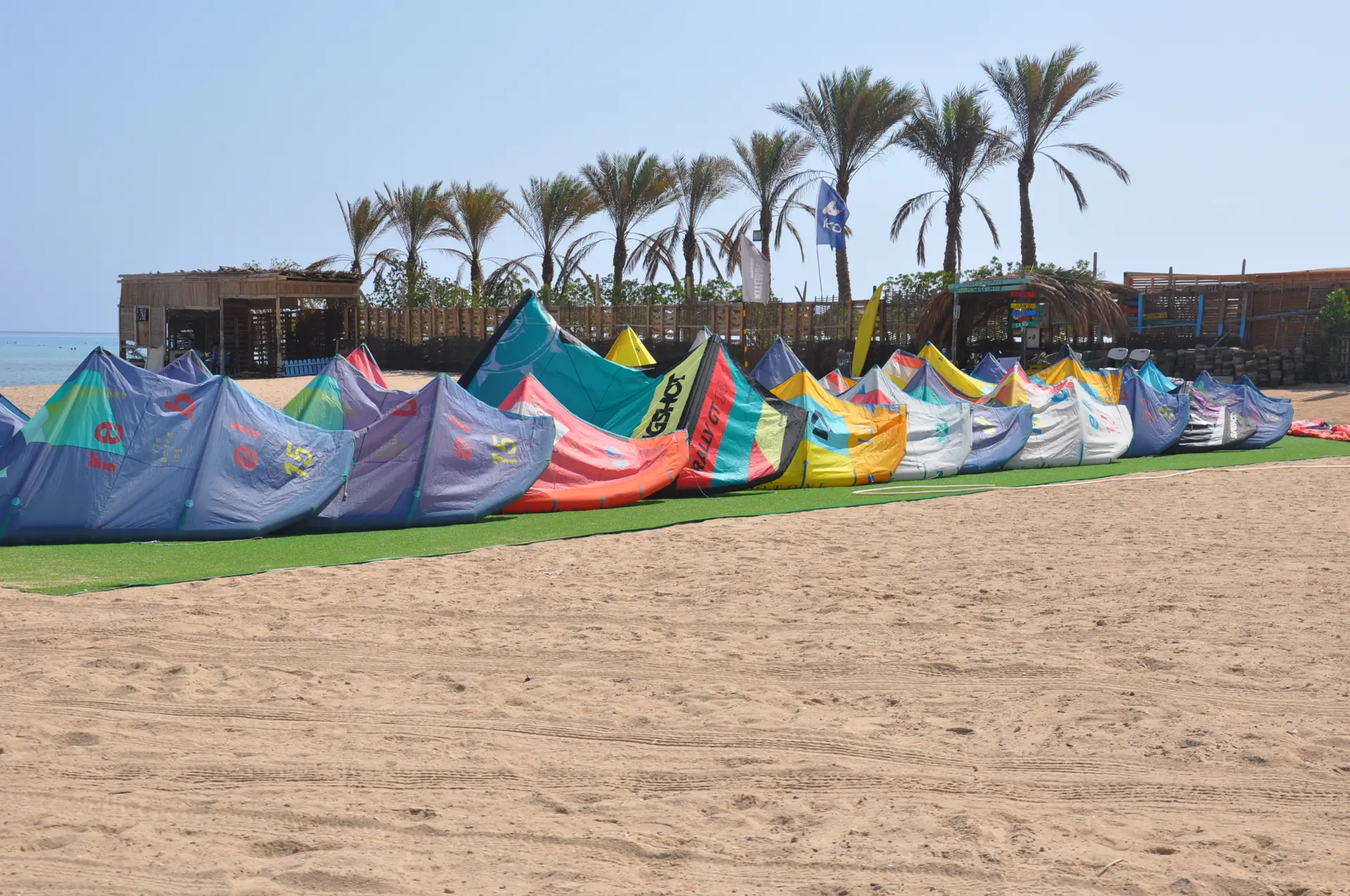
The rule of thumb has two halves: the heavier you are and the lighter the wind, the bigger the kite; the stronger the wind, the smaller the kite. Because the wind changes, riders use several sizes. KiteMood's supervised rental, for example, lists kites of 6 m, 7 m, 9 m, 10 m, 12 m, 13 m, 14 m and 15 m. Size is the canopy area in square metres (m²), often shortened to "m".
One manufacturer, Airush, publishes a size guide for beginner to intermediate riders on twintips. Wind is in knots and kite sizes are in m²:
| Rider weight | 10-13 knots | 14-17 knots | 18-22 knots | 23-28 knots |
|---|---|---|---|---|
| 60-70 kg | 12-14 | 10-11 | 8-9 | 6-7 |
| 70-80 kg | 13-15 | 11-12 | 9-10 | 7-8 |
| 80-90 kg | 14-17 | 12-13 | 10-11 | 8-9 |
| over 90 kg | 15-17 | 13-14 | 11-12 | 9-10 |
The manufacturer calls this a guideline: board type, kite design and riding style all change the ideal size, and the page does not mention gusts.
Cautions
- Smaller is the safer mistake. The manufacturer says a smaller kite with good de-power is easier and safer than a big, overpowered one, and that if you are between two sizes you should choose the smaller, especially when learning.
- Do not stretch the table. It covers about 10 to 28 knots. Typically, twintip riders need roughly 10 to 12 knots or more, but big kites and other kit work lower, so there is no universal minimum.
- Gusts pull two ways. One retailer advises choosing by the strongest readings rather than the weakest: the safety-first choice, but it leaves you short of power in the lulls. The worked example below shows how far apart the two sizes can be. When the gap is wide, ask someone who knows the spot, or wait for a steadier day.
Who chooses the kite
In lessons you never have to choose: the instructor picks the kite after checking the conditions on the beach. If you ride on your own, the choice is yours, so ask which sizes are available and for advice on the day. KiteMood's equipment rental page explains who can rent without supervision, and the gear guide covers the kit itself.
When not to go out
No article can give you a safe number. The limit depends on your skill, your kites, how gusty the wind is and what rescue is available. These are the conditions that make careful riders stay ashore:
- The wind is offshore and there is no rescue boat.
- The gusts are far above the steady wind, and you could not say how you would handle the peaks.
- Your smallest kite would overpower you. However good the day looks, it is over.
- You cannot judge the wind. If in doubt, do not launch. Judging wind strength, direction and quality is part of KiteMood's Level 2 – Intermediate lessons.
- A storm or squall is approaching.
- Nobody could help if something went wrong. At KiteMood, renting without supervision means being an independent rider who can ride upwind.
Instead, take a lesson: the instructor checks the wind, chooses the kite and stays in touch by radio. If you have completed IKO Level 2 including 2I but are not yet independent, supervised rental adds an IKO Assistant Instructor and boat rescue on standby. The wider rulebook is in kitesurfing safety rules for beginners.
Too little wind is not dangerous, it just ends the session, because the size table starts at about 10 knots. Kitesurfing vs wing foiling compares how much wind each needs.
How to read a kitesurfing wind forecast, step by step
- Check the unit. Knots, km/h, mph or m/s? Convert before you judge anything.
- Pick your hour, not the day. KiteMood describes a typical windy day as wind starting from around 10:00, getting stronger through the day, picking up around 14:00 and going down in the evening. A single daily figure hides that rhythm.
- Read steady wind and gusts together, and note the gap.
- Check the direction against the shore. Onshore, cross-shore or offshore? If you cannot tell, ask.
- Watch the trend. Is the wind building or easing? The wind forecast page shows a live reading and the next 24 hours for the lagoon, in knots.
- Match it to your kit, using the table, or the calculator on the wind forecast page, which suggests a twintip size from your weight and the wind speed. It is a rule of thumb for flat water, not an exact answer.
- Remember it is a model. The page uses a weather model (Open-Meteo), so it can differ slightly from what you feel on the beach. Ask people on the spot.
- Add the feel. In kitesurfing you are mostly out of the water, so wind chill matters more than in surfing. KiteMood advises a long wetsuit all year, or long or shorty in summer (about the lagoon).
A worked example
Imagine a forecast line that reads: Thursday 14:00, wind 28 km/h, gusts 41 km/h.
- Unit: km/h. Divided by 1.852, that is about 15 knots, gusting about 22.
- Gap: about 7 knots, so a gusty day rather than a steady one.
- Kite: for a 75 kg rider, the table gives 11 to 12 m² for the steady wind and 9 to 10 m² for the gusts, about 2 m² smaller.
- Decision: the numbers alone do not settle it. Direction, your level and what you see on the beach do.
For how the months compare, read the best time to kitesurf in Marsa Alam. To ask what the wind is doing today, use the contact page.


